Why Does Nigerian Food Taste Different With Firewood?
Why Does Nigerian Food Taste Different When Cooked With Firewood?
But is it just nostalgia, or is there actually a reason why firewood-cooked food tastes different?
Let’s explore the science, cooking techniques and traditional secrets behind this familiar Nigerian cooking experience.
Why Does Nigerian Food Taste Different When Cooked With Firewood?
1. The Smoky Flavour Makes a Difference
One of the biggest differences between firewood cooking and gas cooking is the presence of smoke.
When wood burns, it releases smoke containing various aromatic compounds. Some of these compounds can interact with food, especially when the cooking pot is exposed to smoke.
This can create a subtle smoky aroma that people associate with traditional cooking.
However, the intensity depends on the type of wood, how it burns and how the food is prepared. Too much smoke can produce an unpleasant flavour, so smoky does not automatically mean delicious.
2. The Heat Is Not Always the Same
Unlike gas cookers, where you can adjust the flame with a control knob, firewood cooking requires more attention.
The fire may become stronger or weaker depending on the amount of wood, airflow and arrangement of the fire.
This means the cook must constantly monitor the pot and adjust the fire.
Sometimes, the changing heat allows food to cook at different rates, influencing its texture and final taste.
3. The Cooking Pot Also Matters
Have you noticed that traditional outdoor cooking often involves large, heavy pots?
The type and thickness of the cooking pot can influence how heat spreads through food.
A thick pot may distribute heat differently from a thin aluminium pot. This affects how quickly food cooks and how easily it burns at the bottom.
It is not necessarily the firewood alone responsible for the difference. The cooking equipment also plays an important role.
4. Why Does Firewood-Cooked Jollof Rice Taste Special?
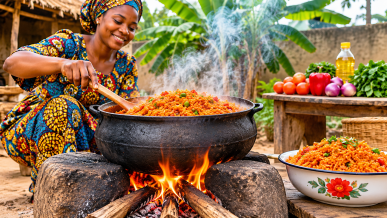
Nigerian jollof rice is one of the meals people frequently associate with traditional firewood cooking.
When prepared in a large pot over firewood, several things can influence its flavour:
- The heat distribution throughout the cooking process.
- The way the tomato and pepper mixture is fried.
- The amount of liquid used.
- The cooking time.
- The development of a slightly toasted layer of rice at the bottom.
That slightly toasted rice layer is particularly loved by many jollof enthusiasts.
However, achieving delicious jollof is not exclusive to firewood. A well-prepared pot of jollof on a gas cooker can be equally delicious.
Why Does Nigerian Food Taste Different When Cooked With Firewood?
5. The Type of Firewood Can Influence the Aroma
Not all firewood produces the same aroma.
Different woods have different natural compositions, moisture levels and burning characteristics.
Dry, untreated wood generally burns more cleanly than wet wood. Wet wood tends to produce more smoke and incomplete combustion.
It is important to use clean, untreated firewood and cook in a well-ventilated area. Smoke from burning wood contains harmful particles, so excessive exposure should be avoided.
6. The Secret Ingredient Might Actually Be the Cook!
Let’s be honest: sometimes, what makes traditional Nigerian food taste unforgettable is not the cooking method but the person preparing it.
Our mothers and grandmothers often cooked with experience rather than measurements.
They knew when the pepper had fried sufficiently, when the meat was tender and when the soup needed another ingredient.
These skills, combined with familiar ingredients, patience and years of experience, contributed to the distinctive taste of traditional meals.
Can You Recreate the Firewood Taste With a Gas Cooker?
Yes, you can recreate some of the flavours and textures associated with traditional firewood cooking without using firewood.
Here are a few tips:
- Use fresh, quality ingredients.
- Allow your stew base to cook properly.
- Avoid rushing the cooking process.
- Use a suitable heavy-bottomed pot.
- Pay attention to heat control.
- Allow flavours to develop gradually.
You do not need to expose yourself to wood smoke to enjoy delicious Nigerian food.
Why Does Nigerian Food Taste Different When Cooked With Firewood? Final Thoughts
Firewood cooking is an important part of Nigerian food culture. Beyond the smoky aroma, it represents traditional knowledge, family gatherings and cooking practices passed down through generations.
Although modern cooking appliances offer convenience, traditional cooking methods remain part of the food memories many Nigerians treasure.
We would love to hear your opinion!
Have you ever tasted Nigerian jollof rice cooked over firewood? Did you notice a difference? Share your experience in the comments.
9jaFoods – Celebrating Nigerian Food, Culture and Everyday Kitchen Discoveries.