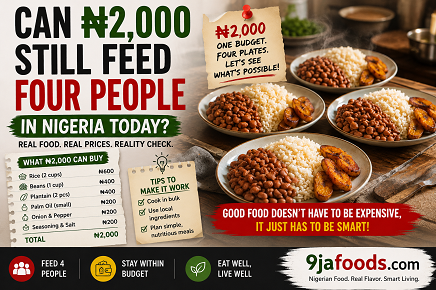
Can ₦2,000 still feed four people in Nigeria today?
Can ₦2,000 Still Feed Four People in Nigeria Today?
Imagine having only ₦2,000 in your pocket and four hungry people waiting for dinner. What would you buy?
Rice? Beans? Garri? Noodles? Yam?
For many Nigeria households, this is no longer just a social-media challenge. It reflects a difficult reality: how do you prepare a filling and reasonably nutritious meal when your food budget is extremely limited?
The cost of feeding a family has become one of the biggest everyday concerns for Nigerians. Although Nigeria’s overall inflation rate has eased, food prices remain under significant pressure. The National Bureau of Statistics reported food inflation of 20.31% year-on-year in July 2026, with fresh pepper, onions, tomatoes, rice, garri, plantain, beef and eggs among the foods contributing to the increase.
So, can ₦2,000 still feed four people?
The answer is complicated.
The ₦2,000 Nigeria Food Challenge
Let’s imagine a family of four needs one meal.
The first rule is simple:
No expensive protein, luxury ingredients and No large shopping list. Just ₦2,000.
Immediately, the choices become difficult.
In Lagos, for example, a recent market survey found that a derica of imported long-grain rice averaged about ₦1,025, while Nigerian manufactured rice averaged around ₦964.
That means a significant portion of the ₦2,000 budget could disappear on rice alone.
And rice still needs something to go with it.
Tomatoes, onions, pepper, seasoning, oil and protein can quickly push the cost beyond the budget.
This is where Nigerian food creativity begins.
What About Beans?
Beans can be one of the most useful staples when trying to create a filling meal on a budget.
They provide protein and can be prepared in different ways. A family could cook beans and serve it with a small portion of another affordable staple.
However, prices vary considerably across Nigeria.
The National Bureau of Statistics reported an average March 2026 price of about ₦1,325.85 for 1kg of brown beans, while state-level averages ranged from considerably lower to considerably higher.
That variation matters.
A family shopping in one state may be able to make ₦2,000 stretch further than a family shopping in another.
Nigeria: And Then There Is Garri
Garri remains one of Nigeria’s most flexible staples.
It can be soaked and served with groundnuts or other available additions. It can also accompany soups and stews.
According to March 2026 figures reported from the NBS Selected Food Price Watch, the average price of white loose garri was about ₦801.54 per kilogram, although prices varied significantly between states.
More recent Lagos market tracking has also shown that garri prices can move upward even when some rice prices are falling.
That means there is no single answer to the ₦2,000 question.
The smartest option depends on where you shop, what is in season and what you already have at home.
The Secret Ingredient: What Is Already in the Kitchen?
This may be the biggest difference between feeding four people with ₦2,000 and failing the challenge.
If a household already has:
- Salt
- Seasoning
- Cooking oil
- Pepper
- Onions
- Spices
- Rice
- Beans
- Garri
then ₦2,000 can go much further.
But if the family has to purchase every single ingredient from scratch, the budget becomes much harder to manage.
This is why food budgeting is not only about the amount spent at the market.
It is also about planning ahead.
Could Noodles Save the Day?
Noodles are another popular option for households looking for something quick and inexpensive.
But feeding four people means buying enough portions, and adding eggs or vegetables increases the cost.
A July 2026 Lagos market tracker estimated a five-person serving of instant noodles with egg at about ₦1,851, illustrating that even a seemingly inexpensive meal can consume almost the entire ₦2,000 budget.
And that’s before considering drinks, fruit or an additional side.
What About Protein?
This is where the challenge becomes particularly difficult.
A meal can be filling without being nutritionally balanced.
Meat, fish and eggs can significantly increase the cost of a family meal. Yet protein is an important part of a healthy diet.
The challenge therefore should not simply be:
“How can I make ₦2,000 produce the biggest pot of food?”
It should be:
“How can I make ₦2,000 produce the most nutritious meal possible?”
That changes the way we think about budgeting.
Nigerian Families Are Becoming More Creative
One thing Nigerians have never lacked is creativity in the kitchen.
Leftover rice becomes fried rice.
Extra beans can become akara.
Overripe plantains can become a different meal.
Vegetable scraps can contribute to soups and sauces.
A small quantity of stew can be stretched with vegetables.
And when meat becomes too expensive, households may reduce the quantity or use alternatives.
These strategies can help families reduce waste and make ingredients last longer.
But there is an important distinction:
Being creative with food is good. Being forced to compromise on nutrition because food is unaffordable is not.
Can ₦2,000 Really Feed Four?
If we’re talking about a complete meal purchased entirely from scratch, the answer in many Nigerian cities today is:
It can be extremely difficult.
However, if a household already has basic ingredients at home, ₦2,000 can sometimes be used to prepare a simple meal for four.
Market location also makes a huge difference.
Recent data show considerable differences in food prices between Nigerian states. Even the prices of everyday staples such as beans, garri, onions and eggs can vary substantially from one location to another.
So, the ₦2,000 challenge does not have one universal shopping list.
The Bigger Problem Behind the Challenge
The real story isn’t whether someone can cleverly prepare a meal for four people with ₦2,000.
The bigger question is:
Why does feeding a family have to be such a difficult calculation?
Food is a basic human need.
Families should be able to purchase nutritious food without constantly worrying about whether their money will reach the end of the shopping list.
Nigeria’s food-price situation also affects farmers, traders, transporters and consumers. Fuel costs, transportation, production expenses, weather, supply and market conditions can all influence what eventually appears on a family’s dinner table.
Five Ways to Make ₦2,000 Stretch Further
1. Plan Before Shopping
Don’t enter the market without knowing what you want to prepare.
A plan helps prevent unnecessary purchases.
2. Compare Prices
The first seller isn’t always the cheapest.
Check different stalls when possible.
3. Buy Seasonal Foods
Foods that are abundant during certain periods can sometimes offer better value.
4. Reduce Food Waste
Don’t throw away food that can safely become part of another meal.
5. Think Nutrition, Not Just Quantity
A huge pot isn’t necessarily a healthy meal.
Try to combine affordable carbohydrates, vegetables and available protein sources where possible.
The Final Verdict
So, can ₦2,000 still feed four people in Nigeria today?
Yes, sometimes—but with serious limitations.
It depends on the location, current market prices, what ingredients are already available at home and the type of meal being prepared.
For some families, ₦2,000 may produce a simple meal.
For others, it may barely cover one major ingredient.
And that is precisely why this challenge matters.
It turns a simple amount of money into a window into the everyday reality of Nigerian households.
The creativity of Nigerian families deserves recognition.
But creativity should not have to replace affordability.
The 9jaFoods Take on Can ₦2,000 Still Feed Four People in Nigeria Today?
The ₦2,000 food challenge isn’t really about proving that Nigerians can survive on a tiny budget.
It is about understanding how far money actually goes when a family needs to eat.
So, here’s our question for you:
If you were given ₦2,000 today to feed four people, what would you cook?
Would you choose rice?
Beans?
Garri?
Noodles?
Yam?
Or would you create something completely different?
Tell us your ₦2,000 meal plan.
Because sometimes, the most interesting Nigerian food stories begin with the smallest budgets.