The Cost of Food in Nigeria: Why Market Trip Feels Different
The Cost of Food in Nigeria: Why Every Trip to the Market Feels Different
For many Nigerians, that experience has become familiar. The cost of food in Nigeria is affecting what families buy, how young people budget, where they shop, and even what ends up on the dinner table.
The question used to be simple: “What are we cooking today?”
Now, however, another question is becoming increasingly common: “What can we cook with what we have?”
From university students managing weekly allowances to young workers trying to survive in expensive cities, rising food costs are changing everyday decisions. At the same time, Nigerians are becoming more creative about finding affordable ways to eat well.
Cost of Food: The Numbers Are Telling a Story
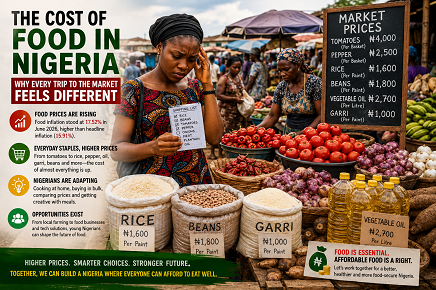
Nigeria’s food-price situation cannot be understood through everyday conversations alone. According to the National Bureau of Statistics, food inflation stood at 17.52% in June 2026, while headline inflation was 15.91%.
However, statistics can sometimes make the situation sound more distant than it actually is.
For a family, food inflation may mean buying less meat. For a student, it could mean replacing a restaurant meal with food prepared at home. Meanwhile, a young worker might discover that the amount spent on groceries each month is steadily taking a larger share of their income.
That is why hearing that inflation has slowed does not necessarily mean that food has suddenly become cheap.
Instead, it means prices may be increasing more slowly than before. The prices Nigerians are already paying can still remain high.
Cost of Food: Why Does Food Cost So Much?
Food does not simply appear on a market stall.
Before that bag of rice reaches your kitchen, it may have passed through farmers, processors, transporters, wholesalers and retailers. Consequently, every stage of the journey can add another cost.
Transportation is particularly important. When fuel and logistics become more expensive, moving food from farms to cities can also become more expensive.
Farmers, meanwhile, have their own challenges. Seeds, fertiliser, labour, equipment and other inputs all require money. If production becomes more expensive, those costs can eventually reach consumers.
Therefore, the price of food is not simply about what happens at the market.
It is the result of an entire journey from farm to plate.
The Tomato Test
If you want a simple way to understand Nigerian food prices, look at tomatoes.
Tomatoes have almost become an unofficial economic indicator in everyday Nigerian conversations. One week, you may be planning a huge pot of stew. The following week, you might find yourself calculating whether you can afford enough tomatoes to make it happen.
Recent reports have highlighted tomatoes, peppers and several staple foods among items contributing to food-price pressure.
Yet tomatoes are only one part of the story.
Rice, beans, yam, garri, crayfish, palm oil, eggs and meat can all affect the final cost of a meal. As a result, even small increases across several ingredients can make an ordinary family meal surprisingly expensive.
Sometimes, therefore, the problem is not one dramatic price increase.
Instead, it is ten small increases meeting inside one cooking pot.
Cost of Food: Jollof Rice Has Entered the Conversation
Jollof rice is much more than a meal in Nigeria.
It represents celebration, family, parties and culture. Nevertheless, it can also tell us something about the country’s changing food economy.
Think about everything that goes into a typical pot of jollof rice: rice, tomatoes, pepper, onions, oil, seasoning and, depending on the occasion, meat or chicken.
When several of those ingredients become more expensive at the same time, the final meal naturally costs more.
Recent reporting has highlighted the rising cost of preparing jollof rice as part of the wider cost-of-living pressure facing Nigerians.
In other words, the rising cost of jollof is not just about rice.
It is about what happens when multiple food costs come together.
Young Nigerians Are Becoming Budget Food Experts
Interestingly, one of the most visible responses to rising food prices is coming from young Nigerians themselves.
Instead of simply asking what they want to eat, many are beginning to ask different questions:
- What can I afford?
- What will last longer?
- What can I cook in bulk?
- Which ingredients can I use for several meals?
- Where can I get this cheaper?
As a result, young Nigerians are becoming increasingly strategic about food.
Social media has also created a growing appetite for budget-food content. Rather than watching only expensive recipes and restaurant reviews, young people are searching for affordable meal ideas, student recipes, food hacks and ways to stretch limited budgets.
For example, the question “What can I cook with ₦2,000?” can generate far more practical interest than a recipe requiring expensive ingredients.
This is more than a social-media trend. It reflects the economic reality facing many young people.
Cost of Food: Eating Out Is Becoming a Calculation
There was a time when buying lunch outside could feel like a simple convenience.
Today, however, that decision can require serious mental mathematics.
Add the meal, transport, delivery fees, a drink and perhaps a small extra charge, and suddenly one lunch can consume a significant portion of the day’s budget.
Consequently, some young Nigerians are eating out less frequently. Others are choosing cheaper street-food options, while many are returning to home cooking.
Yet convenience has not disappeared.
Instead, people are looking for a better balance between price, quantity, taste and convenience.
That balance is likely to influence Nigeria’s food industry for years to come.
The Return of Home Cooking
Another interesting development is the renewed importance of the home kitchen.
Cooking can be tiring, especially for young people balancing school, work, business and other responsibilities. Nevertheless, when prepared meals become too expensive, cooking at home starts looking less like a chore and more like a financial strategy.
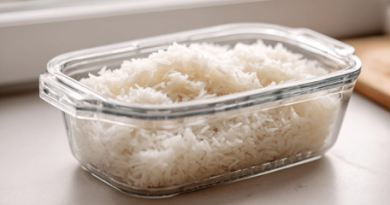
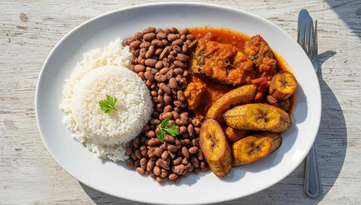
A large pot of rice can provide several meals. Likewise, stew can become the foundation for rice, yam, plantain or other dishes throughout the week.
With some planning, leftovers can also be transformed rather than thrown away.
Therefore, home cooking is increasingly becoming about more than tradition. For many Nigerians, it is now about value and survival.
Cheap Does Not Always Mean Healthy
There is, however, an important side to this conversation.
When money becomes tight, people naturally search for meals that are filling and affordable. Unfortunately, the cheapest option is not always the most nutritious.
That means Nigeria’s food conversation needs to go beyond simply asking:
“How can people eat for less?”
We also need to ask:
“How can people eat affordably and still get nutritious meals?”
This matters particularly for children, students and young adults whose health and development depend on access to balanced diets.
As food prices continue to influence household decisions, affordable nutrition should therefore remain part of the conversation.
The Hidden Opportunity
Although rising food costs present serious challenges, they also create room for innovation.
For young entrepreneurs, the situation could inspire affordable meal services designed specifically for students and young workers. Similarly, farmers could benefit from better production, storage and distribution systems.
Technology could also play a larger role.
For instance, digital platforms could help consumers compare prices, connect directly with producers or discover affordable food options nearby. At the same time, better storage and processing could help reduce food waste and make seasonal produce available for longer.
There is also enormous potential in local ingredients.
Instead of relying heavily on expensive imported products, young Nigerian entrepreneurs can explore the possibilities of cassava, plantain, beans, millet, sorghum, yam and other locally available foods.
In this way, today’s food challenge could become tomorrow’s business opportunity.
The Market Has Changed—and So Have We
Ultimately, the cost of food in Nigeria is changing much more than grocery bills.
It is changing behaviour.
Families are planning meals differently. Young people are comparing prices more carefully. Some households are buying in bulk, while others are reducing unnecessary spending.
At the same time, consumers are paying greater attention to food waste, portion sizes and value.
In a sense, Nigerians are becoming food economists without necessarily knowing it.
Every market visit teaches a lesson about budgeting, supply, demand and purchasing power.
Cost of Food: What Happens Next?
Nobody can predict exactly where food prices will go next. Nevertheless, one thing is clear: food will remain one of the most important economic issues affecting Nigerian households.
The solution cannot simply be telling people to “manage.”
Nigeria needs stronger food production, better transportation networks, improved storage, reduced food waste and more efficient markets. In addition, policies that make nutritious food more accessible will be essential.
Young Nigerians also have an important role to play.
They can farm, innovate, build food businesses, develop technology and educate their communities. More importantly, they can look at today’s challenges and ask better questions.
- How can food become cheaper?
- How can food become healthier?
- How can less food be wasted?
- How can farmers earn more while consumers pay less?
Those are the questions that could shape the future of Nigerian food.
The Takeaway
The next time you walk into a market and wonder why your money suddenly feels smaller, remember that there is a much bigger story behind that price tag.
The cost of food in Nigeria is connected to farming, transportation, energy, climate, markets, income and consumer behavior. At the same time, it is connected to something Nigerians have never lacked: creativity.
We have always found ways to turn simple ingredients into incredible meals.
Now, perhaps, that same creativity needs to move beyond the kitchen.
Nigeria needs young people who will not simply complain about expensive food, but imagine better ways to produce, distribute, preserve and prepare it.
Because the future question is no longer simply:
“What are we eating?”
It is:
“How can we build a Nigeria where everyone can afford to eat well?”
And that is a question worth putting on every Nigerian table.