Smart Ways Nigerians Can Stretch Meals
Smart Ways Nigerians Can Stretch Meals: Discover practical ways Nigerian families can stretch meals, reduce food waste, plan smarter, reuse leftovers and save money in the kitchen. When Food Is Plenty but Money Is Tight
Food prices continue to influence how Nigerian families plan their meals. Sometimes the problem isn’t that there is no food in the house—it is that the available money has to cover food, transport, school needs, electricity, and other household expenses.
The good news is that stretching your food budget does not always mean eating boring meals. With a little planning, leftovers, smart shopping and creative cooking, one pot of food can go much further.
Smart Ways Nigerians Can Stretch Meals: Plan Your Meals Before You Shop
One of the easiest ways to waste money is shopping without knowing what you intend to cook.
Before going to the market, check what is already available at home. You may discover that you already have rice, beans, garri, pasta, seasoning or vegetables that can form the basis of several meals.
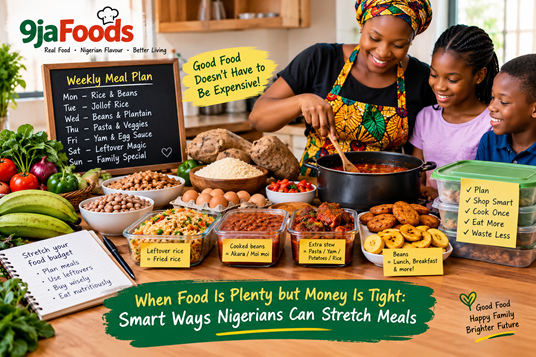
Create a simple weekly plan such as:
- Monday – Rice and beans
- Tuesday – Jollof rice
- Wednesday – Beans and plantain
- Thursday – Pasta with vegetables
- Friday – Yam or potatoes with egg sauce
- Saturday – Leftover transformation day
- Sunday – A special family meal
Meal planning helps reduce unnecessary purchases and makes it easier to control spending.
Learn the Art of the Second-Day Meal
Not every leftover needs to look like yesterday’s food.
Leftover rice can become fried rice, jollof rice or rice balls. Cooked beans can be turned into bean porridge, akara or moi moi. Extra stew can become a sauce for pasta, yam, potatoes or rice.
This is especially useful in Nigerian homes where cooking large quantities can sometimes be more economical than preparing tiny portions every day.
The trick is to store leftovers properly and transform them creatively.
Smart Ways Nigerians Can Stretch Meals: Make Beans Work Harder
Beans are one of those foods that can appear in several forms.
A single batch can provide different meals throughout the week:
- Beans + plantain can become lunch.
- Beans + garri can make a simple filling meal.
- Beans + bread can become breakfast.
- Beans transformed into akara or moi moi can create something completely different.
Adding vegetables, onions, peppers or other affordable ingredients can also make a bean-based meal more interesting.
Smart Ways Nigerians Can Stretch Meals: Don’t Ignore Affordable Local Foods
When planning meals on a budget, expensive ingredients are not always necessary.
Nigerian staples such as garri, beans, yam, sweet potatoes, plantain, maize and local vegetables can be used in many different ways.
For example, vegetables that are in season may cost less than imported or out-of-season alternatives.
Shopping according to what is currently available at the market can therefore help families save money.
Use Eggs Strategically
Eggs are incredibly versatile.
Instead of using several eggs for one meal, you can combine a smaller number of eggs with vegetables, onions and tomatoes to create a generous sauce.
Egg sauce can be served with:
- Bread
- Yam
- Potatoes
- Rice
- Plantain
- Pasta
This turns one simple mixture into several possible meal combinations.
Smart Ways Nigerians Can Stretch Meals: Cook Once, Eat More Than Once
Cooking every single meal from scratch can consume both time and money.
For busy households, preparing a larger quantity of certain foods can make sense, provided they are cooled, stored and reheated safely.
For example, stew can serve as a foundation for different meals throughout the week.
Instead of eating the same plate repeatedly, use it differently each time.
- Day 1: Rice and stew
- Day 2: Yam and stew
- Day 3: Pasta with stew
- Day 4: Beans with stew
The food may be similar, but the meals don’t have to feel identical.
Smart Ways Nigerians Can Stretch Meals: Compare Prices Before Buying
Prices can vary between supermarkets, neighbourhood shops and local markets.
Before buying a large quantity of an ingredient, compare prices where possible.
You should also check whether buying a smaller quantity makes more sense. Bulk buying is not automatically cheaper if some of the food ends up spoiling.
The cheapest food is not necessarily the food with the lowest price tag. The real saving is food that gets eaten rather than wasted.
Smart Ways Nigerians Can Stretch Meals: Store Food Properly
Food waste can quietly destroy a household’s budget.
Vegetables can spoil quickly when they are not stored properly. Cooked food can also become unsafe when left at room temperature for too long.
Use clean, suitable containers and refrigerate food that needs refrigeration. When buying fresh produce, consider purchasing quantities your household can realistically consume.
Good storage can turn a food budget into more meals.
Smart Ways Nigerians Can Stretch Meals: Don’t Throw Away Food Too Quickly
Before throwing something away, ask yourself whether it can safely be repurposed.
Overripe bananas can be used for pancakes or smoothies.
Soft tomatoes can be used in sauces if they are still safe to eat.
Leftover vegetables can be added to eggs, noodles or rice.
However, never eat food that shows signs of spoilage or has been stored unsafely just to avoid waste.
Smart Ways Nigerians Can Stretch Meals: Think Beyond “Cheap Food”
Saving money should not mean completely ignoring nutrition.
A balanced Nigerian meal can include a combination of carbohydrates, protein, vegetables and healthy fats depending on what is available and affordable.
Instead of spending most of the budget on one expensive ingredient, families can spread their money across different affordable food groups.
For example, beans + rice + vegetables can provide a more varied meal than relying heavily on one ingredient.
🇳🇬 The Nigerian Kitchen Is Already Built for Creativity
One of the strengths of Nigerian cooking is versatility.
A basic ingredient can become several completely different meals depending on how it is prepared. That creativity can be especially valuable when household budgets are under pressure.
Stretching your food budget is not about making every meal feel like a sacrifice. It is about planning better, wasting less and making the food you already have work harder.
After all, sometimes the secret to feeding a family better isn’t buying more food—it is making better use of what is already in the kitchen.