How Electricity Affects the Way Nigerians Store/Eat Food
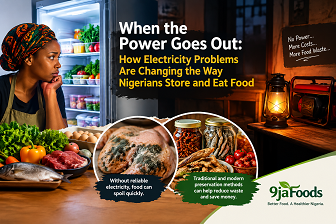
How Electricity Problems Are Changing the Way Nigerians Store and Eat Food
Food doesn’t only become expensive when the price at the market rises. Sometimes, the hidden cost begins after the food has already been bought.
For many Nigerian households, electricity is an important part of keeping food fresh. From refrigerators and freezers to blenders, microwaves and electric cookers, modern food storage and preparation depend heavily on reliable power. But when electricity goes off for long periods, families are forced to find other ways to protect their food.
This creates a problem that is rarely discussed when we talk about food security: What happens to food when there is no reliable electricity?
Electricity Problems: The Refrigerator Is More Than an Appliance
In many homes, the refrigerator is one of the most important food-saving appliances.
It allows families to buy food in larger quantities and store it for several days. Meat, fish, chicken, vegetables, cooked meals and drinks can all be preserved through refrigeration or freezing.
For a family trying to manage a tight budget, this can make a huge difference.
Instead of buying a small amount of meat every day, someone can purchase a larger quantity when prices are better and keep it in the freezer. Instead of cooking three times a day, a family may prepare food in advance and refrigerate it.
But all of this depends on electricity.
When power supply becomes unreliable, the freezer may stop working. The longer the outage lasts, the greater the risk that frozen food will begin to thaw.
That can turn a money-saving strategy into a financial loss.
Electricity Problems: Food Can Become Waste Before You Know It
Food waste is not always caused by people buying too much.
Sometimes, food becomes waste because there is no way to preserve it properly.
Imagine a household buying chicken, fish, meat or other perishable foods for the week. If electricity disappears for an extended period, the food may spoil before it can be eaten.
The family then faces an unpleasant choice: throw the food away or risk eating something that may no longer be safe.
Either option can be painful.
Throwing food away means throwing away money. Eating spoiled food can create serious health problems.
This is particularly difficult for families already struggling with rising food costs.
Electricity Problems: The Cost of Alternative Power
When electricity is unavailable, some households turn to generators, inverters, solar systems or other alternatives.
These solutions can help keep refrigerators and freezers running, but they also come with costs.
Generators require fuel and maintenance. Fuel prices can make running a generator for several hours every day expensive.
Solar power can reduce dependence on fuel, but installing a reliable solar system requires an initial investment that may be beyond the reach of many families.
This means that electricity problems can indirectly increase the cost of food.
A household may buy food at one price, spend additional money trying to preserve it, and still lose some of it when the power situation becomes difficult.
Electricity Problems: How Nigerians Adapt
Nigerian households are known for their creativity, and food preservation is no exception.
When electricity becomes unreliable, people often adjust the way they shop and cook.
Some households buy smaller quantities of perishable foods so they can finish them quickly. Others choose foods that can remain fresh for longer without refrigeration.
Traditional food-preservation methods also become important.
Drying, smoking, salting and fermenting have been used in Nigeria for generations. These methods helped communities preserve food long before modern refrigerators became common.
Smoked fish, dried pepper, dried vegetables and other preserved foods demonstrate that food preservation does not always have to depend on electricity.
In some situations, traditional knowledge can become an important part of modern food security.
The Rise of “Cook What You Need”
Another way electricity problems can influence eating habits is by encouraging households to cook smaller portions.
Cooking a large pot of soup or stew can be convenient, especially for busy families. But without reliable refrigeration, storing the leftovers becomes more difficult.
As a result, some households may choose to cook only what they expect to eat within a short period.
This can reduce waste, but it may also increase the amount of time spent cooking.
For parents and caregivers who already have demanding schedules, this creates another challenge.
Food preparation becomes a daily balancing act between convenience, cost, safety and electricity availability.
Small Food Businesses Feel the Pressure Too
The problem does not stop at the household level.
Small food businesses depend heavily on electricity.
A frozen-food seller needs freezers. A restaurant needs refrigeration. A baker may require electricity for mixers and ovens. A drinks seller may depend on refrigerators to keep products cold.
When electricity becomes unreliable, businesses have to spend more on alternative power.
Those additional expenses can eventually affect customers.
A business owner who spends more on fuel, maintenance or power equipment may have little choice but to increase prices.
In this way, electricity costs can quietly become part of the price of food.
Electricity Problems: Could Better Food Preservation Help?
Improving food preservation could reduce some of these losses.
Affordable solar-powered refrigeration, community cold-storage facilities and improved food-processing methods could help households and small businesses preserve food for longer.
There is also an opportunity to expand education about traditional preservation methods.
Young Nigerians, for example, can learn how drying, smoking and fermentation work and how these methods can complement modern technology.
Food preservation should not be viewed simply as a household issue. It is connected to food security, household income, health and environmental sustainability.
Food Security Is About More Than Having Food
When people hear the phrase “food security,” they often think about whether enough food is available.
But having food available is only part of the story.
People also need to be able to afford, store, preserve and safely consume that food.
A family that buys ₦50,000 worth of food but loses ₦10,000 because of spoilage has experienced a form of food insecurity.
A small business that loses frozen products during a prolonged power outage also experiences food loss.
This is why conversations about Nigeria’s food system should include electricity.
Electricity Problems: A Different Way to Think About Food Waste
We often tell people: “Don’t waste food.”
That message is important.
But we should also ask a bigger question:
Do people always have the resources they need to prevent food from being wasted?
Reducing food waste requires more than telling households to be careful. It requires better infrastructure, reliable electricity, affordable preservation technologies, accessible storage facilities and practical knowledge.
Nigeria already has many traditional methods of preserving food. Combining that knowledge with modern technology could create new solutions for households and businesses.
Because sometimes, the food we lose isn’t food we didn’t value.
It is food we simply didn’t have the right conditions to preserve.
Electricity Problems: The Bigger Picture
The next time you open a refrigerator and find your food perfectly preserved, it may be easy to forget how much infrastructure makes that possible.
Electricity, refrigeration, transportation, storage and food-processing systems all play a role in getting food from the farm to our plates.
When one part of that system becomes unreliable, the effects can reach all the way to the dining table.
And in Nigeria, solving food waste may require us to look beyond the market—and start looking at the power supply too.